BUILDING WITH AI / COMMUNITY OPERATIONS
CONEXÃO TCG
Product builder & operator / Selected 2026 release work
From WhatsApp polls to a recoverable auction.
I used AI-assisted development to build the software behind my Pokémon TCG community. I also built a separate assistant for members. The auction, its records and its payments remain outside the model’s control.
AT A GLANCE
85 polls
Reconciled in Auction 41
44 lots
Won by participants
41 lots
Without a bid
One live auction. These counts describe what was reconciled, not time saved, adoption or improvement attributable to AI.
01 / CONTEXT & ROLE
The chat is where people bid, not where the operation can live.
Collectors already participate through WhatsApp polls. Moving the bidding experience somewhere else would change how the group works. But organizing a sale also means preparing lots, confirming what went out, identifying winners and managing fulfillment. Chat history helps explain what people saw; it is not, by itself, an operational record.
I was both the product builder and the operator. I mapped how work moved from preparing an auction to reviewing the result, then used AI-assisted development to implement and test the operator tools. That gave me a direct feedback loop: when a release created confusion or failed during an auction, I could trace the workflow and turn the failure into a testable requirement.
There were two AI decisions, not one. I used AI in development to build the tools. I also introduced an assistant inside the community for a narrow set of questions. The auction system does not ask that assistant to count votes, identify winners or authorize money movement.
02 / OPERATOR WORKFLOW
Turn a manual process into observable steps.
An auction starts with selecting and preparing lots, then reviewing the group and schedule before anything goes out. Photos and polls represent the same lot, but sending one does not guarantee the other has reached the group. The operator needs to know whether a lot is prepared, partly published, confirmed or still in doubt.
I used those distinctions to define how the app and automation should coordinate. A change to a schedule or a lot is different from an instruction to publish it. At the other end, a won lot and a lot without a bid need different treatment during fulfillment. The records carry those distinctions beyond the chat.
I treated realistic cases as development inputs: a group with dummy names, known test lots and a publish sequence that could be interrupted at a specific step. AI helped me implement and iterate on the flow; I reviewed expected outputs against the actual rules instead of assuming that plausible code was safe to run live.
01 / PREPARE
Review lots, media and schedule
02 / PUBLISH
Track the photo and the poll separately
03 / RECONCILE
Check votes and route won or unsold lots
FIG. 01
Auction scheduling and operator review
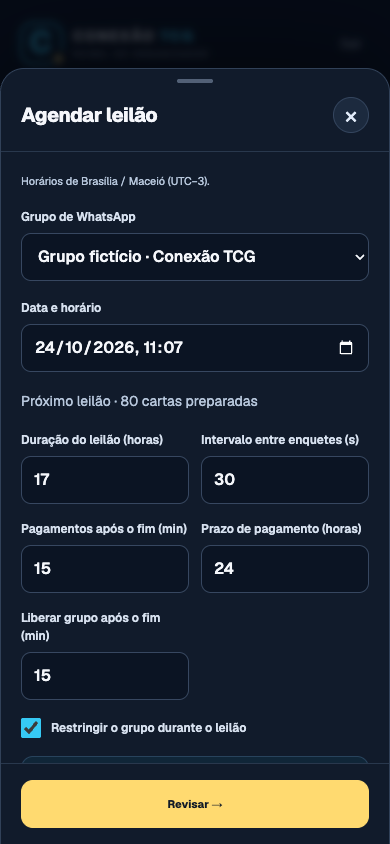
WHAT TO LOOK FOR
Actual Controle TCG interface in a fixture with fictional group data. The operator reviews the timing and target before scheduling.
03 / RECOVERY DESIGN
An uncertain send is not a failed send.
An interruption after a photo or poll is sent can leave two plausible stories: WhatsApp accepted it but the app missed the receipt, or the message never went out. A local identifier is not enough to choose between those stories. Treating every timeout as failure risks duplicate polls and a confusing result for bidders.
I defined when the system could resume on its own and when it should stop for review. It records the attempt before transport and looks for uniquely matching confirmation. If it can confirm only the photo, the poll remains the next step. If the poll is confirmed, it can move on. When the evidence is insufficient, the system pauses rather than sending again.
I used isolated tests for late receipts, duplicate attempts and incomplete reads. Auction 41 illustrates the real operating need: 85 polls were reconciled, of which 44 represented won lots and 41 had no bid. That recovery is not proof that every later reliability change was live, nor a guarantee that missing vote history can always be reconstructed.
01 / CONFIRMED
Continue from the last proven step
02 / PARTIALLY CONFIRMED
Resume only the unconfirmed part when evidence allows
03 / STILL UNCERTAIN
Pause and reconcile before repeating
04 / ASSISTANT SCOPE
Let the assistant answer questions, not run the sale.
I designed the TCG Brain as a separate service for Pokémon TCG and community questions. It can use verified knowledge to help members. Auction publication, custody and payments remain operator workflows with their own rules. A friendly answer should not become a permission check.
A real failure made the boundary concrete: the model identified a request as unrelated but its free-form response still offered to help with it. Classification was not enough. I added a deterministic output rule so an out-of-scope answer returns a controlled redirect instead of whatever prose the model proposes.
I also kept authenticated administrative paths separate from member conversations. A user’s words, a display name or a plausible claim of authority should not grant access. The point of the boundary was to preserve what the assistant is useful for without making its generated text an action channel.
FIG. 02
Separate knowledge and assistant configuration
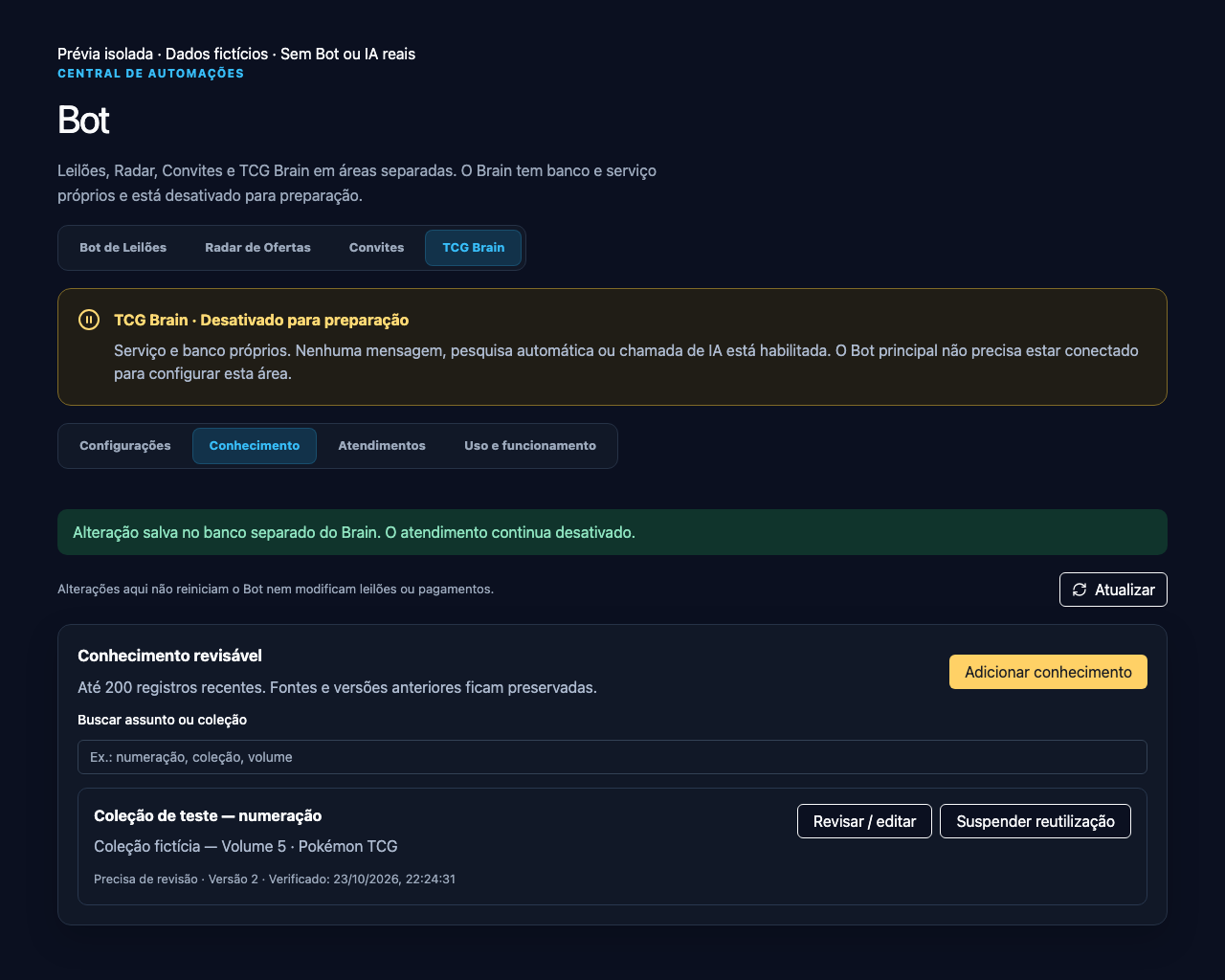
TCG Brain test fixture. This is a different surface from auction scheduling, vote reconciliation or fulfillment.
05 / VALIDATION & REFLECTION
Measure the system and the model separately.
The assistant scope release passed 200 isolated checks, including twelve new scope checks. The guard was subsequently activated. Those checks verify specified behavior, not live answer accuracy, user satisfaction or community adoption. The auction counts describe a different kind of evidence: one real operational event.
My next measures would be operator minutes per auction, ambiguous sends requiring manual review and member questions resolved with a source. I would track them across editions with stable definitions and separate reliability regressions from community growth or changes in auction size.
The project changed what I ask AI to do. It can accelerate implementation and help generate tests from operating scenarios. It should not decide whether a missing receipt means failure, infer administrative authority or guess who won. Those are explicit product rules, and I needed a way to inspect their behavior.